

Meet Detective Inspector Amy: Balancing Leadership and Motherhood
Like many working parents, Amy spends her days juggling competing priorities. The difference is that alongside school runs, football training and remembering World Book Day costumes, she also leads major investigations and makes decisions that can change people’s lives. We caught up with Amy to talk about leadership, motherhood and why the washing basket is never quite empty.
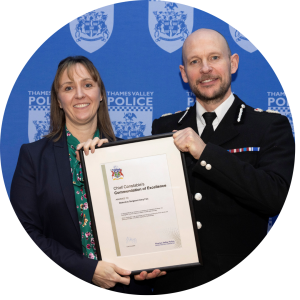 What’s it really like being a female Senior Investigating Officer (SIO) with children?
The honest answer is that it’s rewarding, exhausting, chaotic, and occasionally feels like you’re starring in a sitcom that nobody warned you about.
I’m a mum to a five-year-old boy and an 11-year-old girl, owner of dogs who have absolutely no regard for my workload, and wife to a husband who also has on-call and leadership responsibilities. Between us, our household sometimes feels like a military operation with slightly less planning and considerably more laundry.
How does life change as you move into senior leadership roles?
The responsibility changes significantly.
As you move through the ranks, you’re no longer just responsible for your own workload. As an SIO, you’re responsible for investigations, victims, families, staff welfare, performance, media interest, senior officer scrutiny and making decisions that can have life-changing consequences.
The weight of responsibility is very different.
For women with children, that creates a unique balancing act. You have responsibility for major enquiries, staff management, strategic decision-making, on-call commitments and performance expectations, while simultaneously trying to ensure that somebody has remembered World Book Day, packed a PE kit, booked the dentist and bought new school shoes because, yet again, someone’s feet have apparently grown overnight.
What’s the biggest challenge?
It’s not actually the hours. You can plan around long days. You can’t plan around the unpredictability. A major incident, critical arrest or urgent development can happen at any time and suddenly demand your full attention.
Major investigations don’t care that it’s Sports Day at 9 AM. Unfortunately, neither do children. They just know Mum wasn’t there.
Does promotion make things easier or harder?
Oddly, both.
It’s easier because you often have more autonomy over your diary. You can delegate more, and you’re no longer personally conducting every interview or managing every operational decision.
It’s harder because the strategic responsibility is immense. You’re carrying multiple investigations simultaneously, there is constant pressure to be available, and your decisions are visible across the organisation.
Nobody rings you because everything is going well.
Has family life changed as your children have grown older?
Definitely! Children do get easier as they get older, but they become more aware too.
My 11-year-old now understands why I miss things, why I take calls at dinner and why sometimes I’m physically sat in the room whilst mentally trying to remember something I’ve left unfinished at work. That awareness can actually be more emotionally challenging than when they’re younger.
Is mum guilt real?
Absolutely! The mum guilt is probably the hardest part of all. Children don’t care that you’re a senior leader. They don’t care how complex the investigation is or how many people you’re managing. They just know whether Mum was listening. And sometimes that’s tough.
What have you learned about balancing everything?
One of the biggest things I’ve learned is that perfection simply isn’t an option. The house won’t always be immaculate, every school event won’t be attended, and every enquiry won’t be personally overseen.
And quite frankly, if somebody has invented a nutritious family meal that doesn’t come in a packet, tray or delivery box and takes less than ten minutes to prepare, I’d love to hear about it. Convenience food keeps my family alive. I have accepted this.
What about the mental load of family life?
The mental load is real. What people don’t always see is that whilst dealing with a major investigation, you’re simultaneously thinking about childcare, bills, whether the boiler needs servicing, if the car is due an MOT, whether the dog needs vaccinating, whether any washing has actually made it into drawers, and why school shoes seem to have the lifespan of a carton of milk.
I’ve even tried having a cleaner.
Unfortunately, I discovered I was cleaning the house before the cleaner arrived, which rather defeated the purpose and raised some questions about my own decision-making.
I love gardening too, and it breaks my heart watching the weeds slowly stage a successful hostile takeover of the flowerbeds because I simply don’t have time to deal with them.
Do you make time for yourself?
Not as much as I’d like, I used to enjoy the gym, swimming, and generally doing things for myself. Now, ‘me time’ tends to sit somewhere behind ballet lessons, football aspirations, school activities and everything else family life throws at us.
My eldest has four ballet sessions a week. My youngest has decided football is the next adventure. Jujitsu fell by the wayside because we couldn’t keep up with the early lessons.
I am one extracurricular activity away from needing my own logistics coordinator. Yet somehow, we always make it work.
How important is having a support network?
It’s absolutely critical.
Almost every successful senior woman I’ve met has had some combination of a supportive partner, family support, trusted friends and understanding colleagues.
Trying to be an SIO whilst also being the sole support system for a family is incredibly difficult.
I am very fortunate that many of my colleagues have been incredibly supportive and understanding. There is a genuine culture of helping each other out, swapping duties, covering commitments and recognising that life happens.
That support matters more than people realise.
What helps you stay grounded?
I’ve learned to be deliberate with my time. When I’m at work, I’m at work, and when I’m with my children, I try to be fully present.
The challenge isn’t usually the number of hours available. It’s the fragmentation of attention. Constantly switching between leading a major investigation and helping with homework can be surprisingly difficult.
Can you be a successful SIO and a good parent?
The honest truth?!
You can absolutely have a successful SIO career and be a good mother, but there will be days when you feel like you’re failing at both. The reality is that most of us aren’t failing at either. We’re simply trying to succeed in two roles that both demand an enormous amount from us.
Despite the challenges, what do you love about the role?
I genuinely love the job. The work is meaningful. We safeguard victims, seek justice, support families and lead people through some of the most challenging situations of their careers.
My children are growing up seeing their mum in a leadership role, making decisions and helping people. I hope that teaches them something valuable.
The role has made me more resilient, more confident and a better decision-maker.
The reality is that some weeks everything feels manageable and balanced. Other weeks a major investigation, court deadline, sick child, school issue or family crisis sends the entire plan into orbit.
What would you say to women considering a leadership role in policing?
Don’t wait for the perfect moment because it probably doesn’t exist.
The women who succeed aren’t usually the women who “do it all”. They’re the women who learn to prioritise, ask for help, accept imperfection and recognise that some days they’ll be a better investigator than parent and other days a better parent than investigator.
In short, being a female SIO with children is both hugely rewarding and incredibly demanding. It requires resilience, flexibility, support, humour and a willingness to accept that the washing basket may never, ever be empty.
And if anyone has worked out how to solve that last problem, please let me know. Even the investigations seem easier to manage.
—
To find out more about a policing career with TVP – including the realities of working on a response, initial training, and applying to become a Police Officer, please visit our Police Officer page.
 Facebook
 Linkedin
 Instagram