

50 Years On: One Special Constable’s Unforgettable Policing Journey
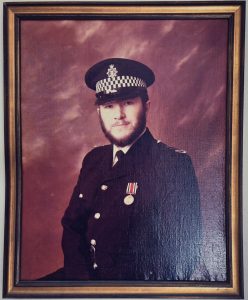
In 1974, while West Germany were winning the World Cup and being the first nation to win the new trophy (the same one that was recently handed to Spain), Phil was signing up as a Special Constable, aged 23. He was looking for a way to see whether policing might be the career for him.
“I wanted to get a taste and see what was going on,” he recalls.
Although he had considered becoming a regular officer, what began as a way to “try before you buy” became more than a decade of service in communities across Berkshire, filled with memorable characters, challenging incidents, and even the chance to meet his future wife.
Looking back more than 50 years later, it is remarkable just how vividly he remembers it all. One of his earliest memories of the police dates back to his childhood and an encounter that could hardly be described as positive at the time.
“I was only ever told off by one police officer,” he laughs. “It was for a bit of reckless bicycle riding!”
To illustrate Phil’s remarkable memory, he recollected that the officer that reprimanded him was sat in a Mk3 Ford Zephyr police car.
“I got a rollicking from that.”
Learning on the job
Training for Special Constables in the 1970s looked very different from what recruits experience today.
“We were given a copy of Moriaty’s law (a seminal UK legal textbook, first published in 1929). We had police law, radio procedure, giving evidence and court procedure, first aid and unarmed combat training,” says Phil. “I actually gave radio procedure lectures to new recruits because I used it all the time in my Ministry of Defence job. There was also a competition known as The Major White Trophy, E Division usually did quite well at this.”
While the classroom element was relatively basic, the real learning happened on the streets.
His first shift was with Reading’s Party One response team, patrolling the town centre on foot alongside an experienced police constable.
“That was an education,” he says. What people forget is that once you put a uniform on and have a warrant card, you have a responsibility that comes with it. If things start kicking off, you can’t stand back. You have to get stuck in. I had no time for ‘uniform carriers’.”
Before long, he found himself helping deal with a fight in the town centre at the Top Rank, serious enough for the whole shift to attend.
“It was a bit daunting, but then I was taller and fitter than I am now.”
Although there was occasionally some scepticism towards Special Constables in those days, Phil says attitudes quickly changed when volunteers showed they were there to work.
“There was still an element of people calling us ‘hobby bobbies’ or ‘overtime takers’, but once they realised you were there to do the job, not just wear the uniform, they came around.”
In fact, he became such a trusted part of the team that local sergeants would sometimes call him at home and ask if he could come in when shifts were short staffed.
The first arrest
One of Phil’s first arrests came after a patient evening of observation at a new housing development at Fords Farm, where thefts had become a regular problem. Bathroom suites and building materials were disappearing almost as quickly as they arrived.
Phil and a colleague parked nearby one Saturday night and waited.
“We knew something was going on because we could hear it.”
Eventually they moved in to investigate and disturbed a man who immediately fled on a bicycle. A chase followed.
“He was as fit as a butcher’s dog!” Phil remembers.
The suspect eventually dived behind a telephone junction box, where the pursuing officers caught up with him.
“When we pulled him out, he pretended to be dead. Then he turned nasty.”
The bicycle itself had been stolen moments earlier from a nearby garage. Like many officers, Phil remembers the mountain of paperwork almost as clearly as the arrest itself.
“That was our first experience of CID 11s. I think the form took about two hours to complete.”
A life saved
One incident while turning out The Coopers in the Butter Market one Saturday night would have a lasting impact on Phil’s career in the Special Constabulary.
When a young woman collapsed and stopped breathing, Phil found himself in exactly the right place at exactly the right time. Thanks to trauma training he had received through his Ministry of Defence role, he recognised the seriousness of the situation immediately.
“She had no pulse.”
Phil began CPR and continued until help arrived. The woman survived.
Word of the incident quickly spread among senior officers, who called Phil in for a meeting. At the time he was juggling increasing responsibilities within the MoD and struggled to get away from work commitments.
Looking back, he believes that moment might have changed the course of his career. He had been encouraged more than once to consider joining the regular police and suspects he may have progressed through the ranks there just as he had in the Specials.
“I do wonder sometimes.”
Dangerous moments
Not every memory is humorous. By now he had been promoted and was serving as a Special Sergeant.
Phil recalls attending a neighbour dispute in Pangbourne that had escalated dramatically. The occupants had upset their neighbours simply by calling their cat indoors. By the time officers arrived, the house had been wrecked.
“There wasn’t a door in the place that was intact.”
As Phil moved around the property, he encountered one of the suspects holding an axe and walking directly towards him.
“I stared at him and stood my ground, and he dropped it – that was quite a scary night.”
Thankfully, the confrontation ended peacefully with two arrests.
Reading football and “The Russian”
Some of Phil’s fondest memories come from policing football matches at Reading. Special Constables were regularly deployed alongside the support group, often positioning themselves where trouble was most likely to occur.
“We used to stand at the back of the South Stand because that’s where the action was going to be.”
On one particularly lively afternoon, Phil and three colleagues found themselves arresting and carrying a troublesome supporter out of the ground.
“We had to carry him down the steps, walk him along the side of the pitch and then back up the steps again.”
The moment even made the Reading Chronicle.
Then there was “The Russian.”
Despite decades passing, Phil still laughs when talking about Reading’s most memorable shoplifter. Officers knew arresting him would require careful planning because he was extraordinarily strong and notoriously resistant.
“If we were told we were going to arrest ‘The Russian,’ usually from The Peacock in Broad Street, we’d need three officers to go down into the pub and another at the top of the stairs ready to pull him out.”
Despite being a prolific thief himself, he had one very specific line he would not allow others to cross. If The Russian heard somebody had stolen from the Broad Street Wollworths, he would track them down himself. Why Woolworths inspired such fierce loyalty remains one of policing’s great unanswered mysteries.
The strangest part of all? Nobody seemed to know why he was called The Russian.
“He wasn’t Russian as far as I recall.”
More than a uniform
For Phil, the Special Constabulary was never simply about wearing a uniform.
“I would often say to the regular PCs, ‘I’m here to help and assist you. I’m not here to take over’.”
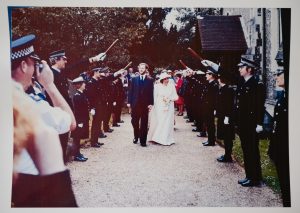
That attitude earned respect from colleagues and helped create friendships that have lasted a lifetime. It also led him to meet his future wife, whose family had a long history of service as Special Constables. They first met at Castle Street police station and their wedding was even featured in Thames Valley Police’s internal newspaper “Thames View.”
Eventually, increasing responsibilities within the Ministry of Defence made volunteering impossible to sustain, and Phil left the Specials in 1985 at the rank of Special Inspector. He later retired from his MOD career in 2010.
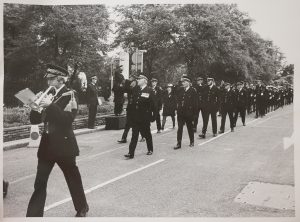
Reflecting on his time in uniform, what stands out most is the camaraderie, the variety, and the opportunity to make a difference. Also the annual general parade in the Forbury where officers were inspected by the ACC, formed up and marched through the town with the force band to St Mary’s Church in the Butts for a service.
“I like to do things and be involved.”
It is a phrase that perhaps explains why volunteering as a Special Constable suited him so well. Whether chasing suspects through housing developments, saving a life through emergency first aid, policing football crowds or helping regular officers on a busy Saturday night, Phil was never short of something to do.
More than fifty years after first putting on the uniform, his memories remain as clear as ever. They highlight exactly why becoming a Special Constable is not just a chance to support your community. It is an opportunity to gain experiences, friendships, and some unbelievable stories that stay with you for life.
Could you create your own memories while making a real difference in the community? Learn more about the Special Constabulary and apply today.
 Facebook
 Linkedin
 Instagram